Steelman · Strawman Risk · Red / Blue / Purple
Understand the strongest version before critique; detect distortion; actively attack assumptions; defend what survives; then combine perspectives to improve the model.
PHYSICAL + DIGITAL RECOVERY ENVIRONMENT · CONCEPT 12 SEPTEMBER 2026
A room for thinking under pressure without letting pressure do the thinking. The concept joins a physical masterclass environment, an evidence-led digital control surface and a public visual language designed to make strong arguments harder to distort, easier to test and easier to correct.
12 SEPTEMBER 2026 · VERSION 2
Bilingual room overview, indicative plan and wall close-ups. Both earlier visualisations are retained below.
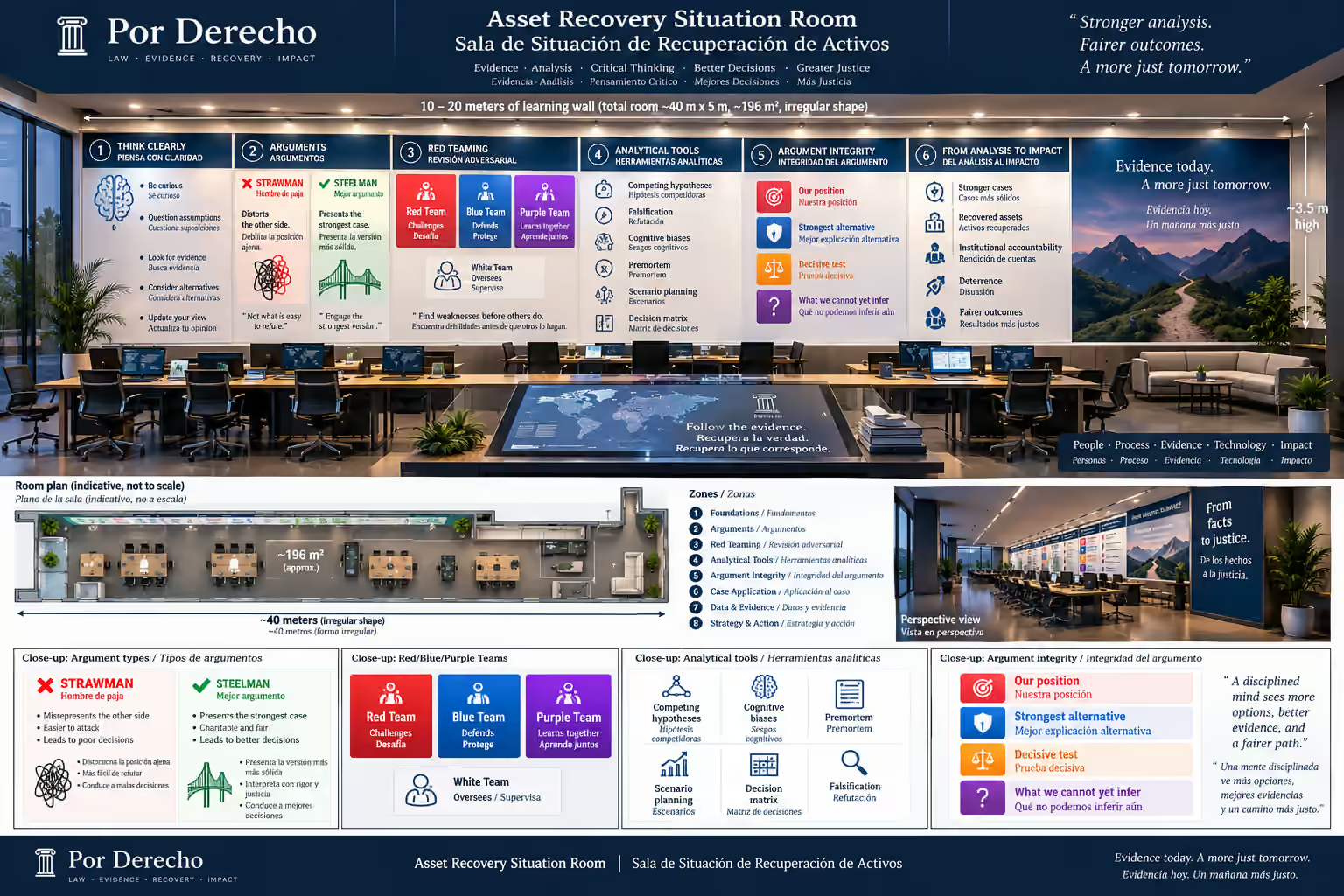
The plan is indicative, not to scale, and does not resolve the irregular 196 m² footprint. Text inside the render is illustrative; the readable HTML explanations on this page are the teaching reference. The protocol retains five fields, including contrary evidence, even where the graphic summarises four.
In this room design, the White Team facilitates the exercise, checks sources and rules, and records disagreement. It does not decide guilt or replace the competent decision-maker.
This does not replace the existing Recovery Command Center or Case Control Room. It gives their underlying discipline a physical and visual form: one environment where lawyers, investigators, regulators, journalists, students and collaborators can inspect competing explanations, move from source to proposition, and see exactly what evidence could strengthen, narrow or defeat a claim.
Earlier visualisations: their compact web copies are retained; original PNG masters are identified by checksum in the provenance record.

THE WALL AS A THINKING OPERATING SYSTEM
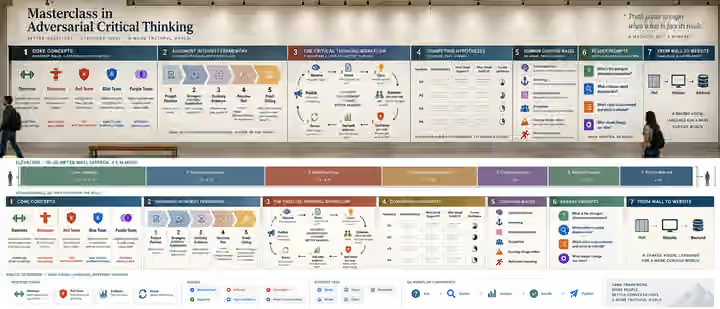
Understand the strongest version before critique; detect distortion; actively attack assumptions; defend what survives; then combine perspectives to improve the model.
Project Position → Strongest Contrary Explanation → Contrary Evidence → Decisive Test → Proof Ceiling.
Observe → Frame → Claim → Steelman → Red-team → Test → Revise → Publish. Publication is a stage in the loop, not the end of it.
Do not ask only what supports the preferred theory. Ask what each hypothesis predicts, what supports it, what falsifies it and what remains unexplained.
Confirmation bias, anchoring, availability, groupthink, Dunning–Kruger and motivated reasoning become explicit failure modes to check.
Prompts move a visitor from passive reading to active testing: alternative explanation, disproof, evidence status and view-changing evidence.
The physical room, public pages and machine-readable evidence graph use the same concepts so a reader-facing card can map back to a structured analytical field.
ARGUMENT INTEGRITY PROTOCOL
What exactly is being alleged or proposed?
What is the strongest reasonable lawful or non-culpable account of the same facts?
Which sources or outcomes pull against the project position?
What finite record, event or comparison would best discriminate between the explanations?
What is the strongest conclusion the present evidence permits—and what does it not permit?
COMPETING HYPOTHESES
| Hypothesis | Example analytical frame | What would support it? | What would falsify or narrow it? | Status |
|---|---|---|---|---|
| H1 | Deliberate wrongdoing or knowing misuse | Actor-specific knowledge, authority, act, documentary use, causal effect and intent evidence | Contemporaneous lawful reason, independent basis, missing knowledge or broken causal link | Evidence-dependent |
| H2 | Negligence / professional or institutional failure | Duty, foreseeable risk, missed safeguards, unreasonable omission | Reasonable professional judgment, no duty/capacity, adequate mitigation | Evidence-dependent |
| H3 | Good-faith mistake or disputed legal interpretation | Ambiguity, incomplete information, contemporaneous reasoning, later correction | Contrary facts personally known and consciously maintained without reconciliation | Evidence-dependent |
| H4 | Lawful conduct plus adverse commercial circumstances | Independent commercial failure, legitimate rights, external causes, ordinary transaction risk | Documents connecting specific acts to avoidable loss or improper benefit | Evidence-dependent |
The objective is not to force every matter into four boxes. It is to preserve live alternatives long enough for evidence to discriminate between them.
READER PROMPTS
Do not make the reader infer that the absence of an alternative equals proof of the preferred theory.
A proposition that cannot identify disconfirming evidence risks becoming unfalsifiable.
Keep source fact, attributed allegation, inference, official outcome and open question visually distinct.
Publish the missing record or event capable of materially strengthening, narrowing or defeating the current analysis.
BACKEND EVIDENCE INTELLIGENCE
The visual grammar can become a machine-readable quality-control layer. For every material hypothesis—especially a serious actor-specific allegation—the evidence graph can require fields that force contradiction, alternative explanation and falsification to travel with the claim.
project_positionsource_refsevidence_statusproof_ceiling
strongest_contrary_explanationcontrary_refslawful_alternativestrawman_risk
decisive_testwhat_would_change_our_viewmissing_evidenceopposing_position_status
Preserve the proposition, source, actor, capacity, date and evidence status.
Attach contrary evidence, competing explanations, bias checks and red-team tests.
When new evidence arrives, revise confidence and public presentation without silently deleting the prior state.
CONTINUITY
The existing Por Derecho architecture already separates recovery operations from the public case-control interface. This concept adds the missing spatial and pedagogical layer: a place where the recovery operating system can be taught, challenged and visually understood while remaining connected to the same evidence graph.
The earlier LinkedIn control-room concept is treated here as background continuity only. The exact historical LinkedIn post text was not recovered from the connected content source during this implementation, so this page does not attribute unverified wording to it.