Separate ownership sits within the hotel’s applicable public-law and private-law framework. Owning one or many fincas does not, by itself, authorise residential conversion, independent tourist operation or withdrawal from binding common obligations. Permission or an exception at one level does not automatically satisfy the others.
1. Land classification, zoning and permitted use
Urbanismo starts with the parcel and building: land classification, planning designation and permitted hotel/tourist use. A separate Registry title does not itself change any of them. Establish the actual planning instrument, parcel coverage and valid changes for the date in question.
2. Planning consents, occupation and changes of use
Works, occupation and any proposed change of use must satisfy the applicable planning and licensing requirements. Owning a unit is not the same as holding permission to convert it, alter shared access or change the authorised use of hotel space.
3. Tourism authorisation and the licensed hotel
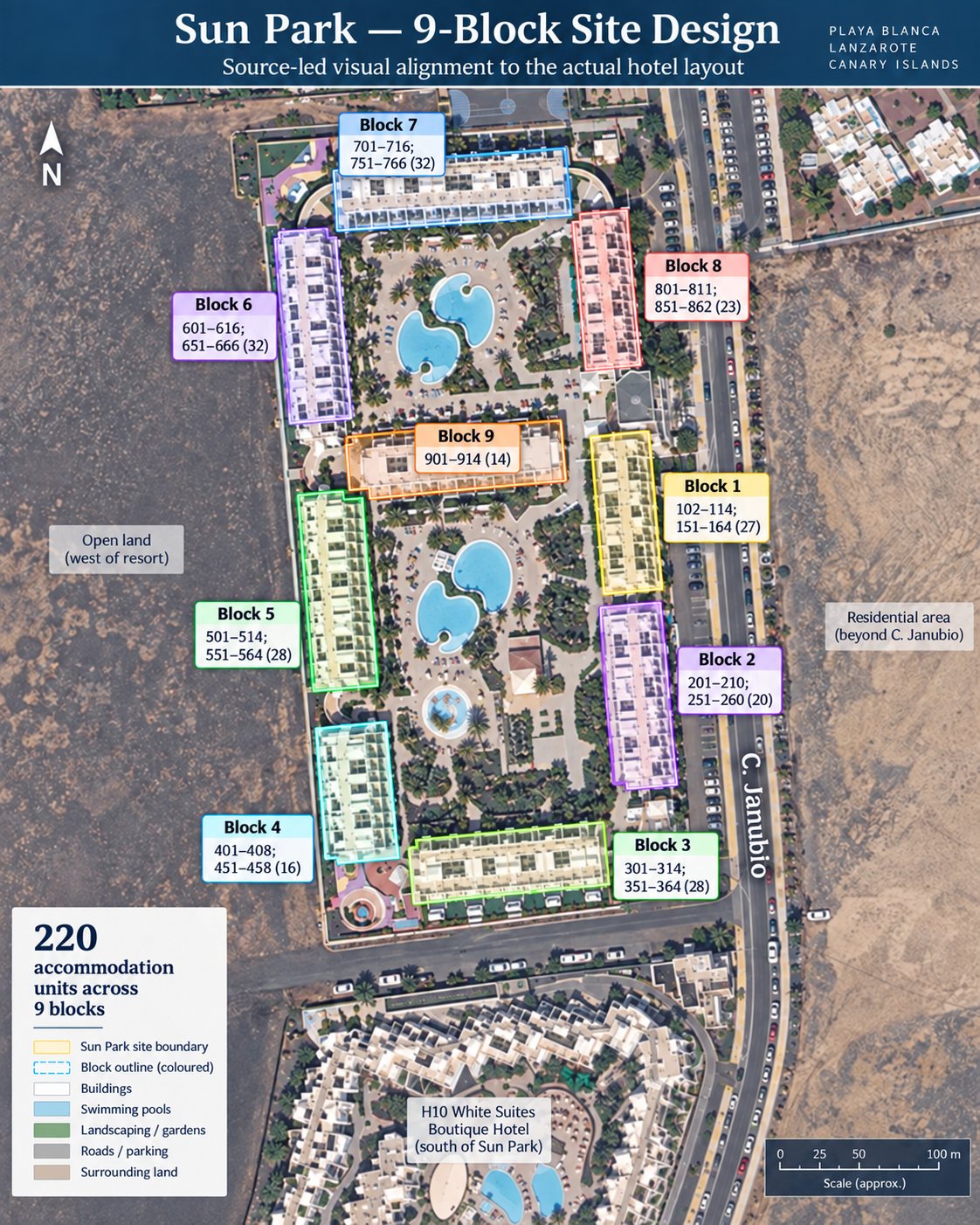
The official 1991 record identifies Sun Park, 220 accommodation units and authorisation on 15 May 1991. Read the actual licence, its unit coverage, conditions and later adaptations. This historical record does not alone certify every later use or provide the 220-line Registry crosswalk.
4. Tourism law in Spain: the Canary Islands framework
Apply the law in force at the event date, including the relevant single-exploitation regime. The reviewed sources include Ley 7/1995, the Ley 5/1999 transition, Ley 10/2001 and Decreto 142/2010. Later legislation must not be projected backwards onto the 1991 authorisation.
5. Horizontal title, CP bylaws and shared responsibilities
Read each title, horizontal division, registered CP statutes and the applicable Ley de Propiedad Horizontal together. The 2014 Registry certification reproduces the 1987 article 6 on single tourist exploitation and restricted direct personal use. Common-property rights carry the applicable duties of conservation, access, cost contribution and respect for others’ rights.
6. CP mandate, exploitation contract and hotel services
CP entrusts exploitation to the operator. The actual mandate and contract determine authorised powers, covered property, duration, services, maintenance and cost allocation for the relevant period. Preserve valid replacement and termination mechanisms. CEXP remains separate; it is not a compulsory title-to-CP or CP-to-operator bridge.
Why one unit can affect the whole hotel
Removing accommodation from coordinated hotel use, obstructing shared access or failing an applicable maintenance duty can affect available capacity and guest services; shift common costs and work onto others; and affect upkeep, safety, regulatory compliance, income and value across the hotel. Shared pools, circulation, utilities and service systems connect these effects beyond the individual title.
Apply the complete rule, including its qualifications
The 1987 statutes also contain premises exceptions, a collective-change provision and a ten-year organisational clause; their later operation and amendments require proof. The 1999 transition includes a more-than-50% rule for qualifying older establishments, and articles 41–42 address dispensations and non-tourist renting. Their actual application needs the licence, adaptation, planning and title record. None alone proves lawful residential use of a Sun Park unit or overrides a valid private restriction. Hotel integration does not itself compel a sale or make one operator irreplaceable.
Controlled source register · PD-CEXP-USE-20260907 · 7 SEP 2026
Historical legal texts: Ley 7/1995 · arts. 38–42 · 2003 · Ley 5/1999 · LPH · 2003 · DL 1/2000 · arts. 164, 166