PD-TRUTH-METHOD-20260925-02 · PD-CONTEXT-INTEGRITY-20260924-01
Truth Machine: document, language, context and network
A recursive forensic architecture that treats each sentence as a testable proposition inside its source, context, actor, capacity, chronology, proceeding, financial flow and evidential lineage.
Data-driven interface · refreshes every 60 seconds · methodology date: 2026-09-25
Architecture
Bytes, hash, version, custody, OCR/transcription.
Source → block → proposition, without losing the whole.
Literal fidelity, modality, quantifiers, attribution, time, causation, context.
Actor, capacity, proceeding, money, reuse and beneficiary.
Contrary evidence, lawful alternative, decisive test.
New source → dependencies → changed/no-change → rerun.
Live demonstration: R33
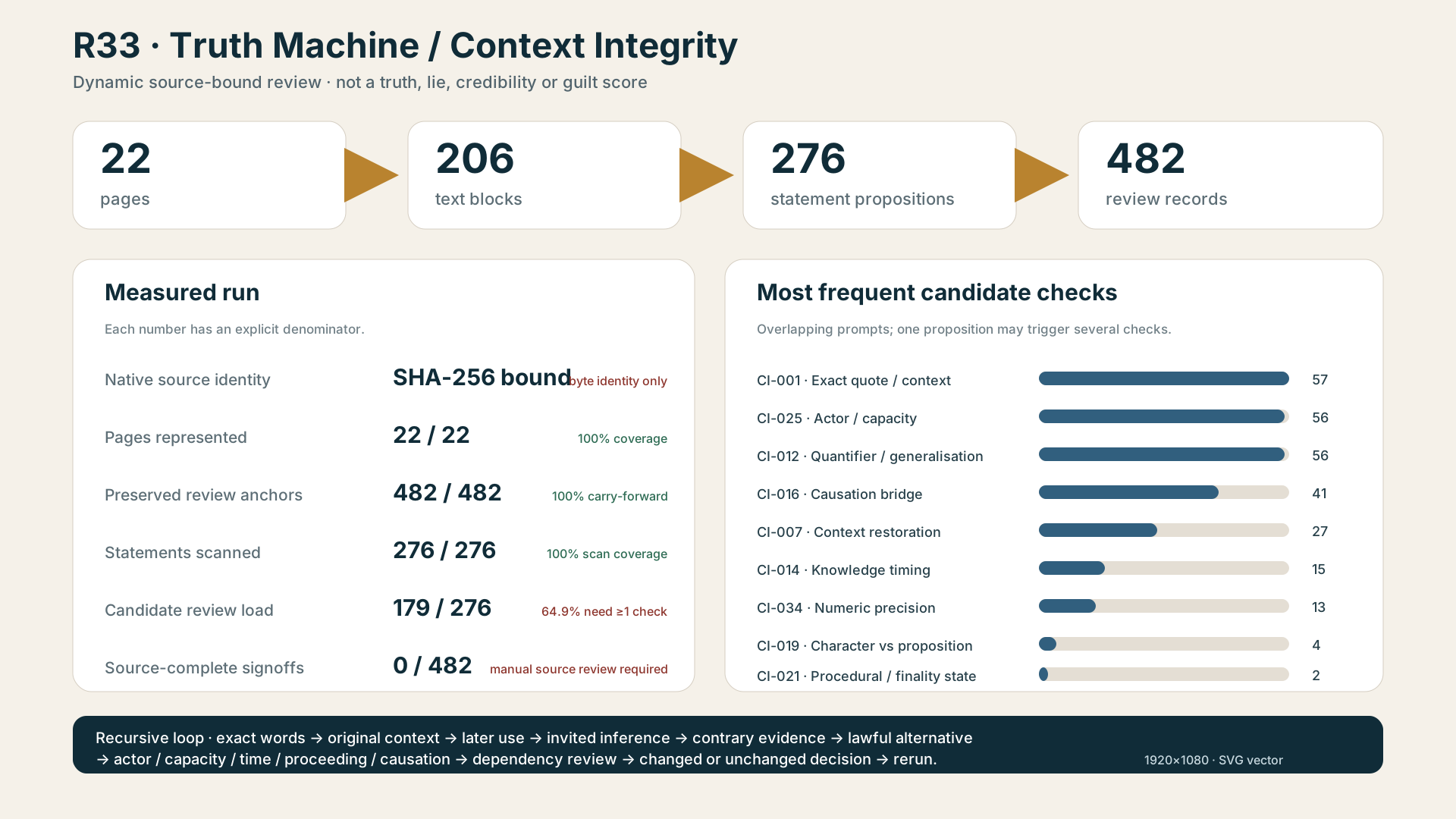
The fallback is a 1920×1080 vector SVG; with JavaScript, the visual is rebuilt from the current aggregate JSON.
Linguistic processing
Agency and forensic-practice lenses
Transferable principles from public sources; no claim that those institutions adopt or endorse Por Derecho.
Recursive priority queue
| # | Document / packet | State | Next action |
|---|
Anti-fragmentation graph
A thematic relationship does not transfer knowledge, intent, control or liability. Every graph edge requires its own source bridge.